


Backflip Madness
Gamesoul Studio
I first approached Backflip Madness as a quick sports game for short breaks, but its appeal became clearer after using it on a shared device. It is easy to understand, quick to pass to another person, and built around the simple pleasure of attempting a difficult stunt again after a failed landing. That makes it a natural fit for a household where people want something casual rather than a long, account-heavy game.
At the same time, it is not a realistic sports simulator or a full parkour adventure. Gamesoul Studio keeps the focus on timing, momentum, and repeated attempts. You choose a stunt, read the situation, tap at the right moment, and learn from the result. My experience was strongest when I treated each attempt as a small challenge instead of expecting a large campaign with deep progression.
How it works on a shared device
A good game for passing around
The most useful household quality here is its low barrier to entry. One person can make an attempt, hand over the phone, and let someone else try without needing a long explanation. That works particularly well during a short wait, a casual gathering, or a break when nobody wants to commit to a complicated multiplayer session.
The game’s sports identity is unusual in a good way. Instead of asking you to manage a team, follow a season, or learn a large set of rules, it turns a backflip into the entire focus. The parkour flavor gives the action more personality than a basic tap-to-score title, but the central skill remains readable: control the movement and aim for a clean landing.
On a shared phone or tablet, I would use a simple turn-taking routine. Each player gets a fixed number of attempts, then passes the device. This prevents the most practiced person from quietly taking over and makes the failures part of the entertainment rather than an argument about who owns the next turn. Because the game is based on precision, a beginner can occasionally beat an experienced player with one well-timed attempt.
Related News

Threads in Real Life: Who Should Join, Lurk, or Leave

How SHEIN Turned Shopping Into an Endless Content Feed

How to Make Fortnite Feel Smarter on Mobile

Should You Switch to Microsoft Outlook on Mobile?

Why Gallery Keeps Pulling Users Back

X Review: Why Its Network Still Matters
The best shared-device use is short, informal competition rather than a formal tournament. The game does not need a scoreboard on the wall to create interest; people naturally compare a successful landing with a spectacular mistake. Still, if several people are playing, it helps to agree beforehand whether you are judging height, style, consistency, or simply the number of successful attempts. Those are different kinds of skill, and mixing them can make the session feel unfair.
Why the simple premise holds attention
Backflip games can become repetitive when the only goal is to repeat the same motion. Here, the appeal comes from the gap between understanding what should happen and actually making it happen. I often knew the right moment to act but still mistimed the attempt. That small difference encourages another try without requiring a long narrative or a complicated reward system.
This also makes it suitable for people who enjoy learning through repetition. If you prefer games where improvement comes from memorizing a route, collecting equipment, or upgrading a character, this may feel too narrow. The satisfaction is more direct: your hands become more familiar with the timing, and a move that looked impossible starts to feel manageable.
Gallery
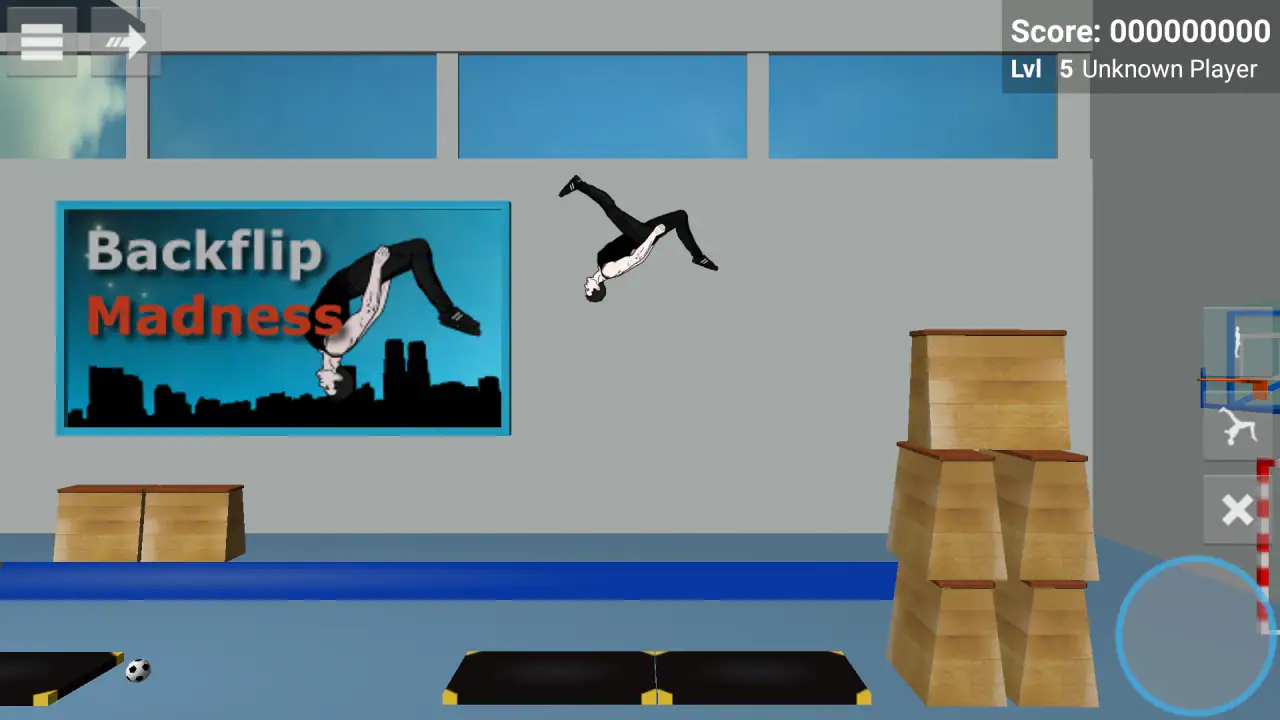
For a household, that distinction matters. A younger player may enjoy the visual comedy of failed landings, while an older player may focus on refining technique. Both can use the same game for different reasons. I would not expect it to replace a party game with several distinct modes, but it works well as a compact challenge that people can revisit without much preparation.
Setting expectations before handing it over
The price is $0.39, which makes the decision relatively easy for someone looking for an inexpensive sports game. The store rating sits at 4.5 from around 27 thousand ratings, and the game has passed 500 thousand installs. Those figures suggest that the straightforward stunt concept has found a sizable audience, but they should not be read as proof that every player will enjoy the repetition.
The content rating is Teen, so I would not treat the game as an automatic choice for every child simply because the controls are easy. The age label is a useful starting point for a family discussion, especially on a device used by several people. I would let a parent or device owner make the final call based on the player’s age and the household’s expectations rather than assuming that a cartoon-like sports presentation is enough to settle the question.
There is also a practical boundary between shared use and personal use. If one person is trying to improve technique, constant interruptions can make the game frustrating. If the goal is laughter and quick attempts, interruptions are part of the fun. Before starting, decide whether the session is practice or social play. That small distinction changes how the failures feel.
What a first session is really like
My first few attempts were less about planning and more about discovering how sensitive the timing feels. The obvious mistake is to tap repeatedly or react too late after the character is already committed to a movement. A better approach is to watch the complete motion, identify the moment that begins the rotation, and make one deliberate input rather than several nervous ones.
That is one of the game’s less obvious lessons: frantic input usually makes a difficult stunt harder to understand. When I slowed down and treated each failed attempt as information, I could tell whether the problem was timing, positioning, or simply choosing a move that was too ambitious for my current consistency. This kind of self-diagnosis is more useful than blindly repeating the same action.
For a shared session, I recommend giving new players a few attempts without commentary. People learn the rhythm faster when they can feel the controls themselves. After that, advice should be specific: “try earlier” or “watch the rotation” is more helpful than saying “be careful.” The game’s challenge is physical and immediate, so vague coaching rarely improves the next attempt.
Coordinating play without built-in assumptions
Because this is a compact single-player-style challenge, household coordination happens outside the game. That is not necessarily a weakness, but it means the device owner should establish the rules. Decide who is playing, how long the session lasts, and whether someone is allowed to restart immediately after a miss. These details sound minor until several people are waiting for a turn.
I found that a “one clean attempt, then pass” rule works better than letting the strongest player continue until they fail. It gives everyone a chance to settle into the controls and keeps the mood relaxed. Another useful variation is to allow one practice round followed by a scored round, with no need to record an exact number. The point is to create a fair rhythm, not to turn a small game into administration.
For siblings or friends using the same phone, a visible handoff is also sensible. The game depends on touch timing, so a player who receives the device while an attempt is already underway may not know what they are supposed to do. Starting a fresh attempt at every handoff avoids confusion and prevents disputes about whether a landing “belonged” to the previous player.
Adults should also remember that a shared device can contain unrelated personal information. The game itself is not a reason to hand over the whole phone without thought. If the device is used for messages, work, photos, or payments, supervise the handoff in the same ordinary way you would with any app. That is a device-management issue rather than a gameplay feature, but it matters in real household use.
Age, trust, and the right kind of supervision
The Teen content rating deserves attention because the game’s accessible controls may make it look younger than its listed audience. I did not find the experience difficult to understand, but ease of control and suitability for a particular age are not the same thing. A parent considering it for a younger player should look at the game together and decide whether the physical-comedy presentation and challenge fit the child.
Supervision is most useful at the beginning, not because the game requires constant coaching, but because the adult can set sensible boundaries. Explain that the stunts are fictional game actions and not instructions for real-world parkour. That is especially important if a child is attracted to the idea of copying what appears on screen. The game is best enjoyed as a timing challenge, not as a demonstration to imitate.
Trust also affects how well it works on a family device. If the player understands that the game is for agreed playtime and will return the device afterward, it can be an easy shared activity. If the household needs strict app-by-app controls, detailed child profiles, or carefully separated accounts, I would look for a different type of product. Backflip Madness is a focused game, not a family-management tool.
The same applies to account boundaries. I would not choose it as a household hub where every player needs a distinct identity, personal progress space, or individual settings. Its strength is immediacy. You open it and play. That is convenient for casual use, but it also means the household should handle ownership and turn-taking clearly outside the game.
Where it stands beside other sports games
Compared with a football, basketball, racing, or skating game, this title is much narrower. There is no need to learn a large roster, plan a match, or understand a full competition structure. That makes it faster to start, but it also limits the variety. If you want realistic rules, team strategy, or a sense of a season unfolding, a conventional sports game will give you more to manage.
Compared with endless runners, it offers a more deliberate challenge. Endless runners usually reward continuous movement and quick reactions as the screen changes. Here, the important moment is concentrated around the stunt itself. I prefer this when I want to practice one precise action rather than react to a stream of obstacles. Someone who enjoys constant forward motion may find the repeated attempts less exciting.
It also differs from physics sandboxes. A sandbox can be entertaining because of unpredictable collisions and experimentation with objects. Backflip Madness is more purposeful: the goal is not merely to watch the character fall in an amusing way, but to understand why the move succeeded or failed. The physics-inspired presentation adds humor, yet the game works best when you treat it as a skill test.
That comparison helps clarify who should skip it. If your ideal sports game includes licensed teams, online competition, deep customization, or a long progression path, this will feel underdeveloped. If you want a small game that can be understood in seconds and still demand practice after the novelty wears off, its narrow focus becomes an advantage.
Practical advice for getting more from it
My first tip is to separate learning from showing off. When playing with other people, it is tempting to choose the most dramatic stunt immediately. That can be entertaining, but it hides the reason for failure. Spend a few attempts learning the basic rhythm before trying to impress anyone. Once the timing feels familiar, harder moves become more informative instead of random.
Second, use a consistent physical setup. Hold the device in the same orientation, keep your hands away from the active area, and avoid changing grip halfway through a session. On a shared phone, different players naturally hold it differently, so a short pause to settle the grip can make the handoff fairer. This is a small adjustment, but touch-based timing games are sensitive to physical inconsistency.
Third, stop after a frustrating streak instead of treating persistence as automatically virtuous. Because the game encourages another attempt, it is easy to continue past the point where attention has dropped. A short break often helps more than ten rushed tries. In a household setting, this also prevents a fun challenge from turning into an argument over the device.
Fourth, compare improvement against your own earlier attempts rather than only against the best player in the room. A newcomer may need time to understand the motion, while a regular player already knows what to watch. Personal progress gives the game a fairer shape and makes it more welcoming for mixed-skill groups.
Finally, remember that the game’s value is concentrated in its controls. If touch response feels uncomfortable on your device or the screen is too small for your grip, the experience may not improve through persistence alone. Try a short session before deciding whether it deserves a permanent place on a shared device.
Device fit and version context
The current version is 1.3.4, and the minimum operating-system requirement is Android 5.0. That makes the game relevant to people who keep an older Android phone for casual use or maintain a spare device for the household. I would still judge the experience on the actual phone, since screen size, touch sensitivity, and physical grip can matter more here than raw specifications.
The low price also changes how I evaluate its limitations. I would not expect the breadth of a premium sports simulation from a $0.39 game. The fair question is whether the central stunt loop is enjoyable enough to revisit. For me, it is, provided I want a focused challenge rather than a large package of modes and systems.
Its release date, Aug 25, 2012, is also useful context when setting expectations. This is an older game concept and should be approached for its direct, compact design rather than for the presentation standards of newer sports releases. Players who value modern interfaces and frequent content expansion may prefer a newer alternative. Players who appreciate simple games with a clear mechanical idea may find the age less important.
Who I would recommend it to
I would recommend it to someone who likes short skill games, enjoys learning timing through repetition, and wants a sports-themed title that does not require a long commitment. It is especially suitable for a shared-device session where people can take turns and laugh at failed attempts. The low purchase price makes it an easy experiment for that audience.
I would also suggest it to a player who is tired of sports games that feel like management tasks. There is no need to remember a complicated strategy before playing. The challenge is immediate, and improvement comes from attention rather than from building a better squad or unlocking a large collection of equipment.
I would skip it if you need robust family separation, personal profiles, or a structured multiplayer experience. I would also skip it if repeated failure feels irritating rather than motivating. The game does not soften its central demand: you must keep observing, adjusting, and trying. That is its identity, but it is not a universal preference.
My household verdict
After using it as both a personal time-killer and a pass-around challenge, I see Backflip Madness as a small game with a clearly defined purpose. It is not trying to be a complete sports world. It gives you stunt timing, quick feedback, and enough difficulty to make a successful landing feel earned.
For a household, the best arrangement is simple: an adult or device owner checks that the Teen rating fits the player, agrees on turn-taking, and treats the game as a shared activity rather than a substitute for account-based family software. With those boundaries in place, it can work surprisingly well on one device because every person understands the objective almost immediately.
My final recommendation is positive but specific. Buy it if you want an inexpensive, focused backflip challenge that can fill a few minutes and support casual turn-taking. Choose a broader sports game if you want teams, leagues, customization, or sustained progression. For the right player, the narrow design is the reason it works: one stunt, one timing problem, and one more attempt to get it right.
FAQs for Backflip Madness
What is Backflip Madness?
Backflip Madness is an arcade-style sports game focused on performing flips, jumps, and other acrobatic tricks. You control a character and try to land increasingly difficult moves in different environments. The game is designed for short, entertaining sessions rather than realistic training, with simple controls, exaggerated physics, and a challenge system that encourages repeated attempts to improve your score.
How do you play Backflip Madness?
Gameplay is based on timing your jumps and controlling the character while airborne. You generally tap or use on-screen controls to initiate flips, adjust rotation, and aim for a safe landing. Success depends on learning the timing of each movement and choosing the right moment to release or change your input. At first, the physics may feel unusual, but practice makes the controls easier to understand.
Is Backflip Madness free to download and play?
Backflip Madness is commonly offered as a free game, although availability, pricing, advertisements, and optional purchases can vary depending on the platform and region. Before downloading, check the current Google Play Store or App Store listing for the latest information. The free version provides the core acrobatic gameplay, while ads or in-app options may affect the overall experience.
Does Backflip Madness require an internet connection?
The main gameplay in Backflip Madness can generally be enjoyed offline, which makes it suitable for quick sessions while traveling or when mobile data is unavailable. However, an internet connection may be needed for downloading the game, receiving updates, displaying advertisements, or using platform-related services. Requirements can change after updates, so checking the store description is recommended.
Is Backflip Madness suitable for children and casual players?
Backflip Madness is easy to start because its objective is straightforward: perform tricks and land successfully. Nevertheless, the physics-based controls can be frustrating for younger players who expect immediate precision. The game contains cartoon-style action rather than realistic violence, but parents should still review its age rating, advertisements, and possible in-app purchases before allowing children to play.
Pros
- Simple controls make flips easy to learn and perform.
- Fast matches are ideal for short gaming sessions.
- Many stunts and landing challenges keep gameplay varied.
- Runs smoothly on most modern Android and iOS devices.
- Funny physics create entertaining fails and replayable moments.
Cons
- Progress can feel repetitive once most tricks become familiar.
- Some advanced moves require precise timing and repeated practice.
- Ads may interrupt play
- depending on the version and device.
- The game offers limited depth beyond performing and landing tricks.
- Visuals are basic compared with newer sports and stunt games.


